
The United States doesn’t operate a single centralised identity register. Instead, businesses typically draw on separate, purpose-built systems, each connecting to a different authoritative source.
Two of the most widely used are AAMVA’s Driver’s License Data Verification (DLDV) service and SSA’s electronic Consent Based SSN Verification (eCBSV) service.
This guide covers what each one checks, how it works, and where it fits into a broader US identity verification and AML strategy.
The Scale of America’s Identity Fraud Problem
Identity fraud in the US isn’t just growing — it’s getting more effective per attempt.
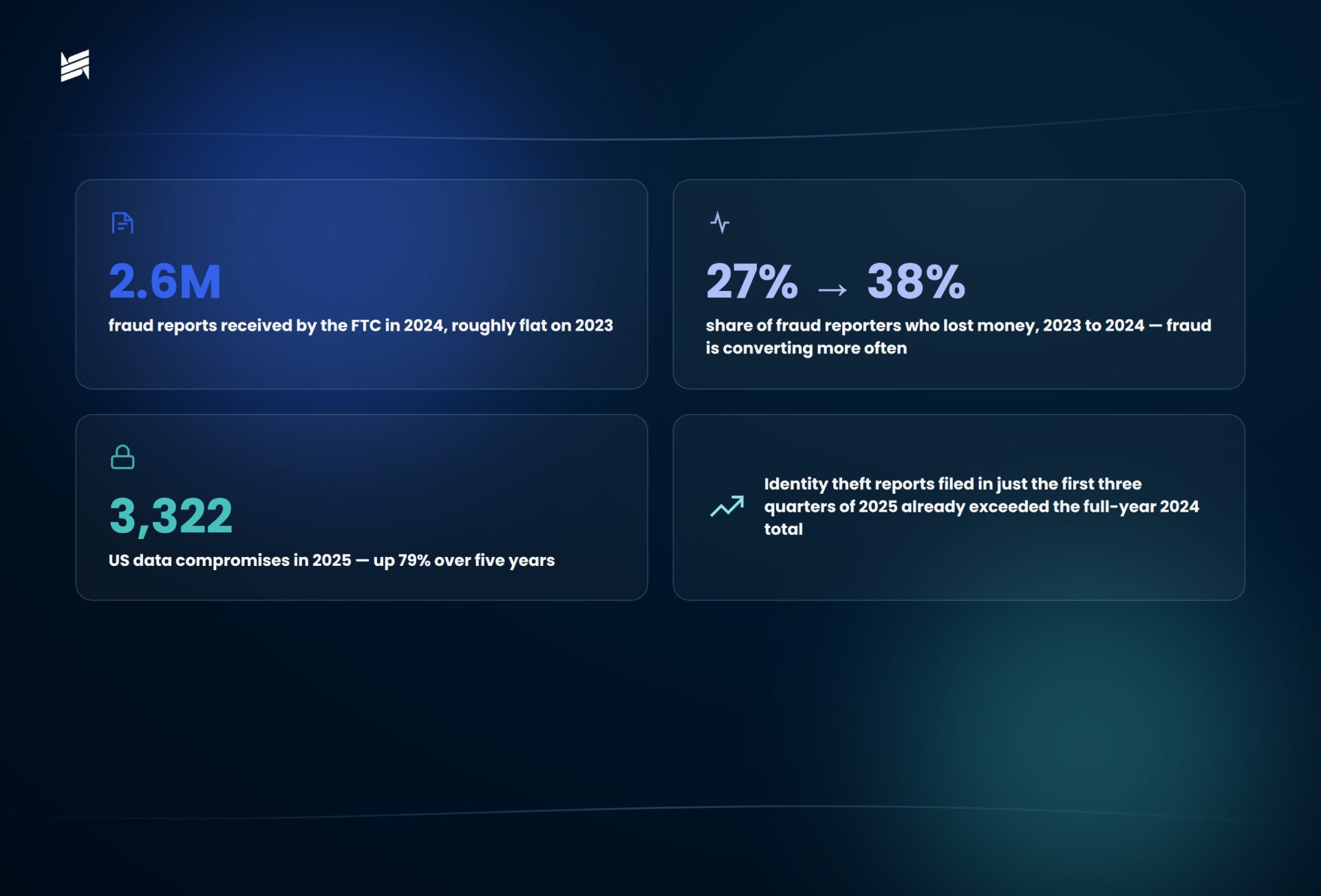
Every one of those breaches puts more names, dates of birth, and Social Security numbers into circulation. That’s exactly the raw material synthetic identity fraud is built from.
Why No Single Check Is Enough in the US
The US doesn’t have one national identity database, and fraud increasingly exploits exactly that gap.
- The FBI’s Internet Crime Complaint Center reported total cybercrime losses crossing $20 billion in 2025
- Adults aged 60 and over accounted for $4.8 billion of those losses alone
- Fraud built on breached data doesn’t announce itself: a stolen SSN paired with a real name and date of birth can look completely legitimate to a single check
That’s the practical case for using AAMVA’s DLDV and SSA’s eCBSV together rather than relying on either alone. Each draws on a different authoritative source, so a fraudster needs to defeat two independent systems, not one.
AAMVA and the Driver’s License Data Verification (DLDV) Service
The American Association of Motor Vehicle Administrators (AAMVA) connects state and territorial motor vehicle agencies through a secure network called AAMVAnet. Its DLDV service lets an approved organisation check driver licence or state ID details against the issuing state’s record.
DLDV works as a real-time, transactional check:
- A business submits the details captured from a licence — name, date of birth, licence number
- The issuing state’s system responds with a flag for each data element, confirming whether it matches
- Because the check queries the issuing agency directly, it reflects the most current record available
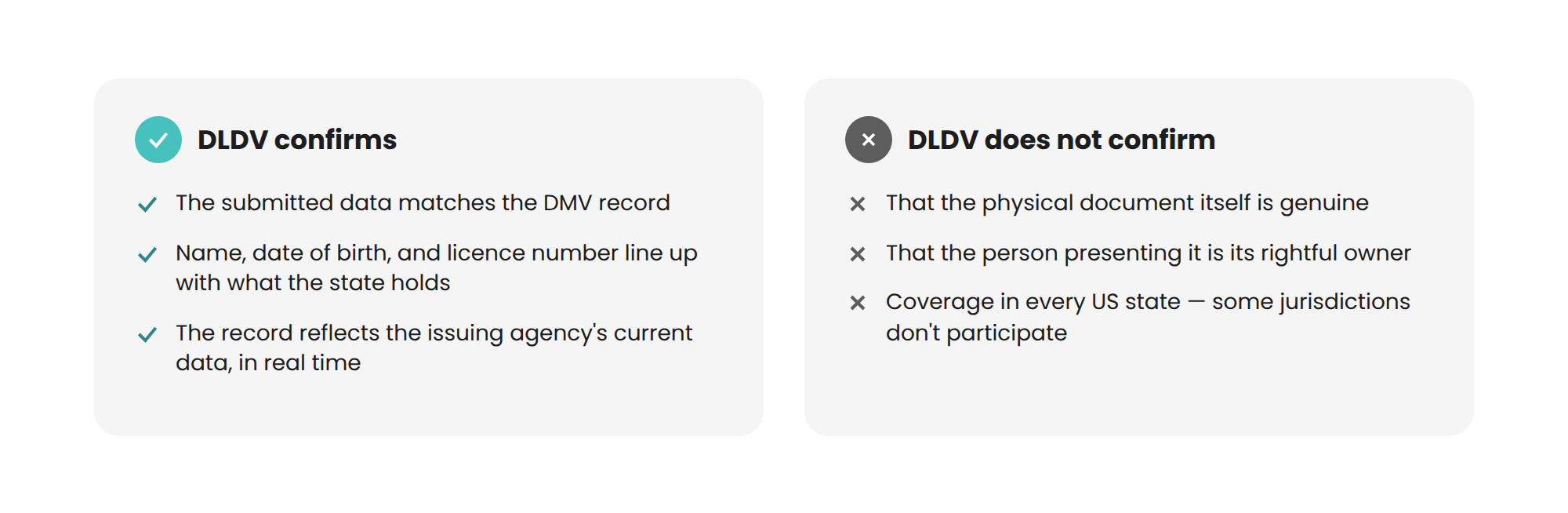
What DLDV Can and Cannot Confirm
It’s important to understand the limits of a DLDV check.
SSA’s Electronic Consent Based SSN Verification (eCBSV)
SSA created eCBSV in response to the Economic Growth, Regulatory Relief, and Consumer Protection Act. The Act directed the agency to build an electronic verification option to help reduce synthetic identity fraud.
eCBSV lets approved financial institutions and their service providers — known as permitted entities — check whether a submitted SSN, name, and date of birth combination matches SSA’s records.
- The service returns a match or no-match response
- If no match, it flags which specific data element failed to match
- Where SSA’s records show the number holder is deceased, the response includes a death indicator
- eCBSV does not verify a person’s identity outright — only whether the SSN and biographic data combination is consistent with SSA’s records
Who Can Use eCBSV, and How Consent Works
Access to eCBSV is restricted.
- Only permitted entities can use it — generally financial institutions and their subsidiaries, affiliates, agents, subcontractors, or assignees
- Requests are only allowed in connection with a credit transaction or another qualifying purpose under the Fair Credit Reporting Act
- A permitted entity must obtain the number holder’s written consent first, which can be a wet or electronic signature
- Every request is logged, and consent records must be retained for a set period
Using DLDV and eCBSV Together
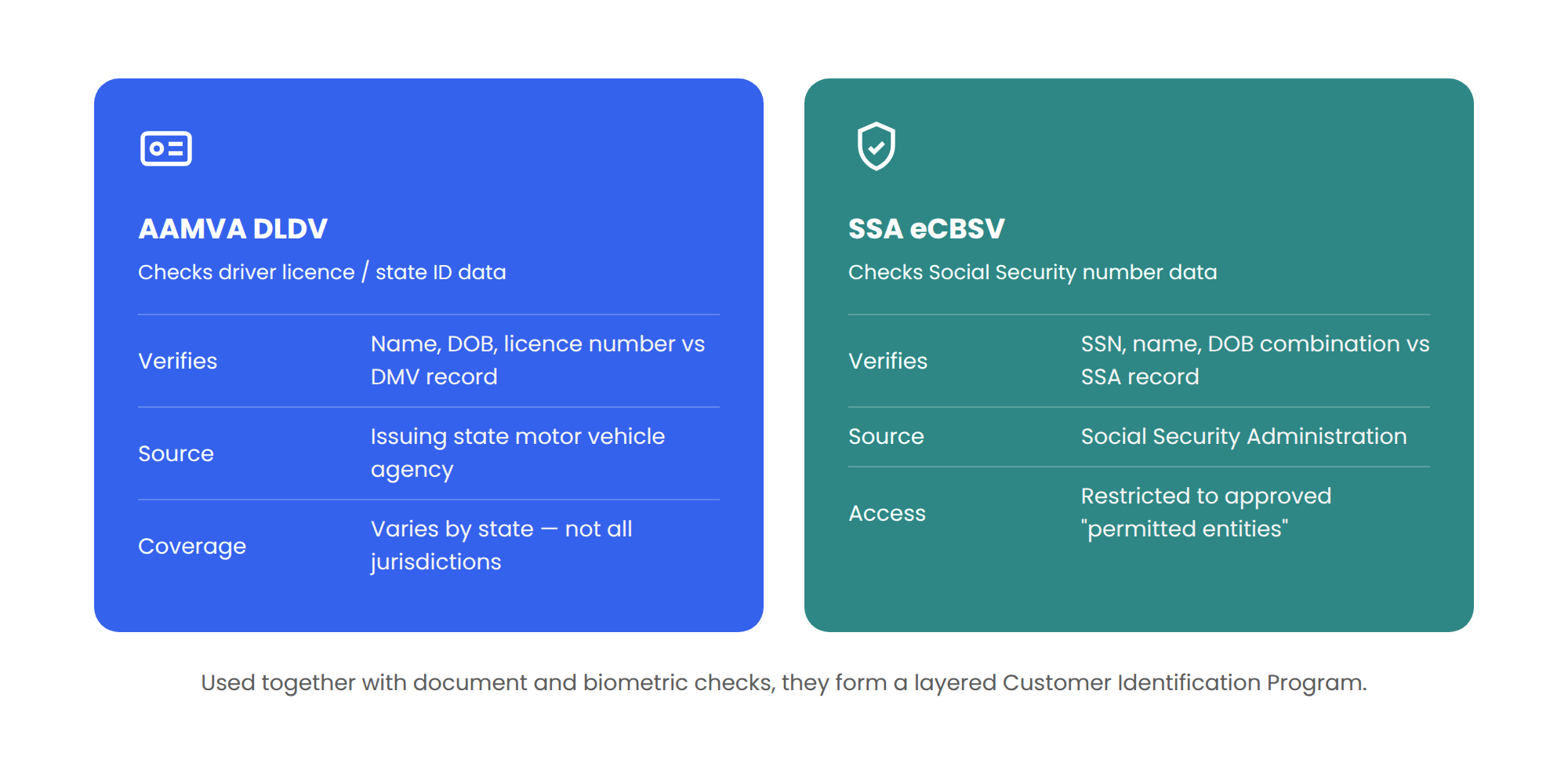
DLDV covers driver licence and state ID verification. eCBSV covers Social Security number verification. Many US businesses use both as complementary layers within a broader Customer Identification Program.
Alongside document authenticity checks, database checks, and biometric verification where appropriate, combining multiple independent sources reduces reliance on any single check. This helps address the gaps that synthetic identity fraud is designed to exploit.
Frequently Asked Questions
Does AAMVA DLDV cover every US state?
No. DLDV coverage depends on which state motor vehicle agencies participate, and coverage has historically excluded some jurisdictions, so businesses should verify current coverage for the states relevant to their customer base.
Can any business access SSA’s eCBSV service?
No. Access is limited to permitted entities, generally financial institutions and their approved subsidiaries, affiliates, agents, subcontractors, or assignees, who must enrol with SSA and obtain the number holder’s consent before each request.
Does eCBSV confirm someone’s full identity?
No. eCBSV confirms whether a submitted SSN, name, and date of birth combination matches SSA records. It does not confirm the person’s overall identity or that they are who they claim to be.
What happens if a DLDV or eCBSV check does not match?
A no-match result does not automatically mean fraud; it may reflect a data entry error, an outdated record, or another explanation. Most compliance programs treat a no-match as a trigger for further review rather than an automatic decline.
Why do businesses use both DLDV and eCBSV rather than just one?
Each service verifies a different, independent data source. Using both, alongside document and biometric checks, provides a more layered and resilient identity verification process than relying on a single check.
Ready to Strengthen Your Identity Verification Approach?
If your organisation verifies US customers, check whether your Customer Identification Program draws on independent, authoritative sources such as AAMVA’s DLDV and SSA’s eCBSV. Combine these with document and biometric checks to build a more resilient defence against identity fraud. Talk to our team about where these services fit into your current onboarding workflow.
0 Comments