
Singapore’s digital identity approach relies on two connected services: SingPass, which proves who someone is, and MyInfo, which shares verified data about them. Both sit under the National Digital Identity programme, part of Singapore’s Smart Nation strategy.
Banks, telecom providers, and other regulated businesses use them widely for onboarding. This article covers the difference between SingPass and MyInfo, how the verification flow works, and why regulators trust MyInfo for Customer Due Diligence.
Why Identity Verification Matters More Than Ever in Singapore
Singapore’s scam data tells a consistent story, even as the headline numbers move in different directions.
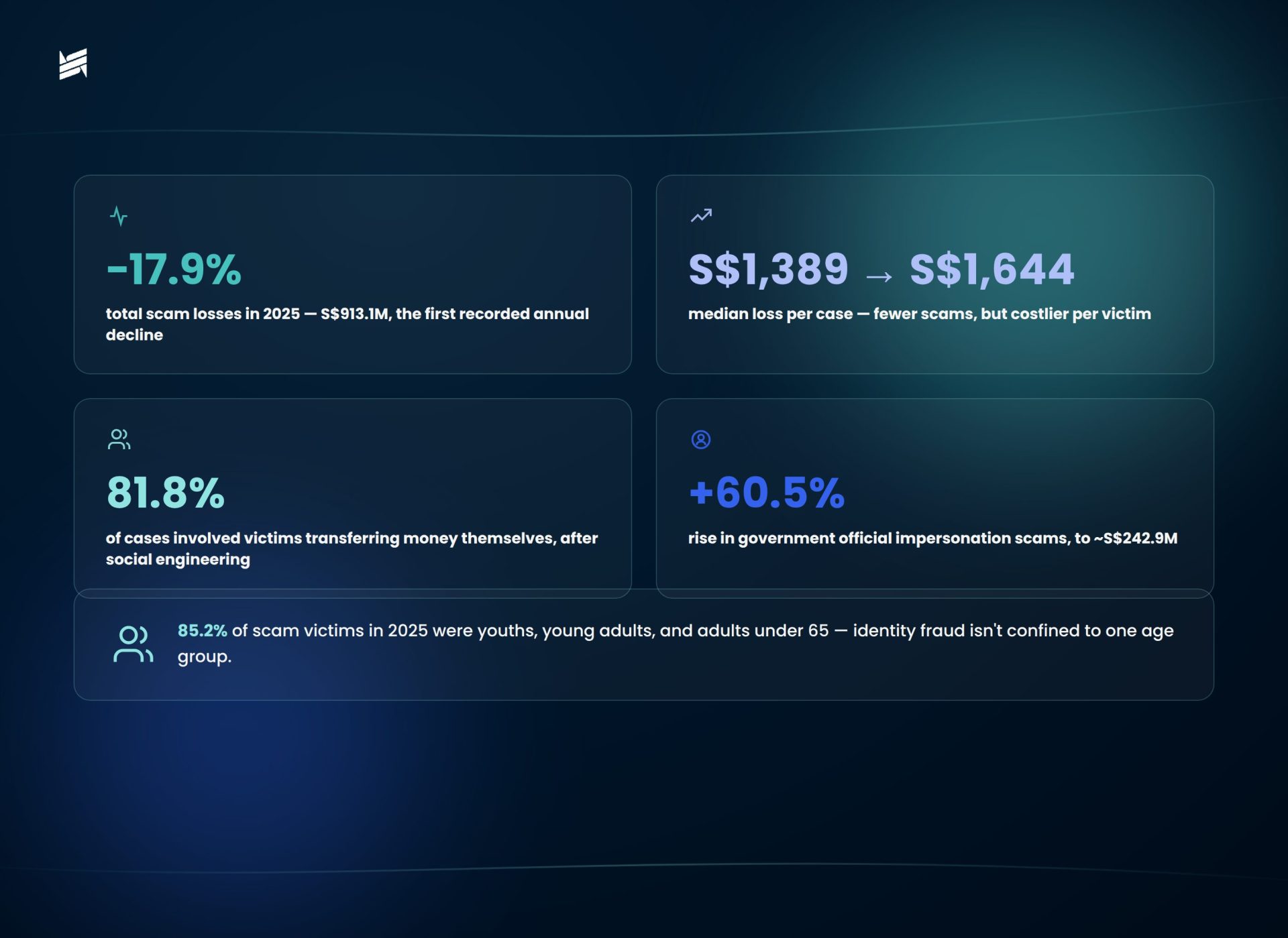
Put together, these numbers point to the same underlying shift: fewer scams are succeeding through brute-force volume, and more are succeeding through convincing impersonation.
That’s exactly the gap identity verification is built to close. A scammer can fabricate urgency or authority in a message, but a government-verified identity record — the kind SingPass and MyInfo provide — doesn’t depend on trusting what the other party claims about themselves.
As impersonation becomes the primary attack method rather than a side tactic, verifying identity against an authoritative source stops being a compliance formality and becomes the actual line of defence.
SingPass: Singapore’s National Digital Identity
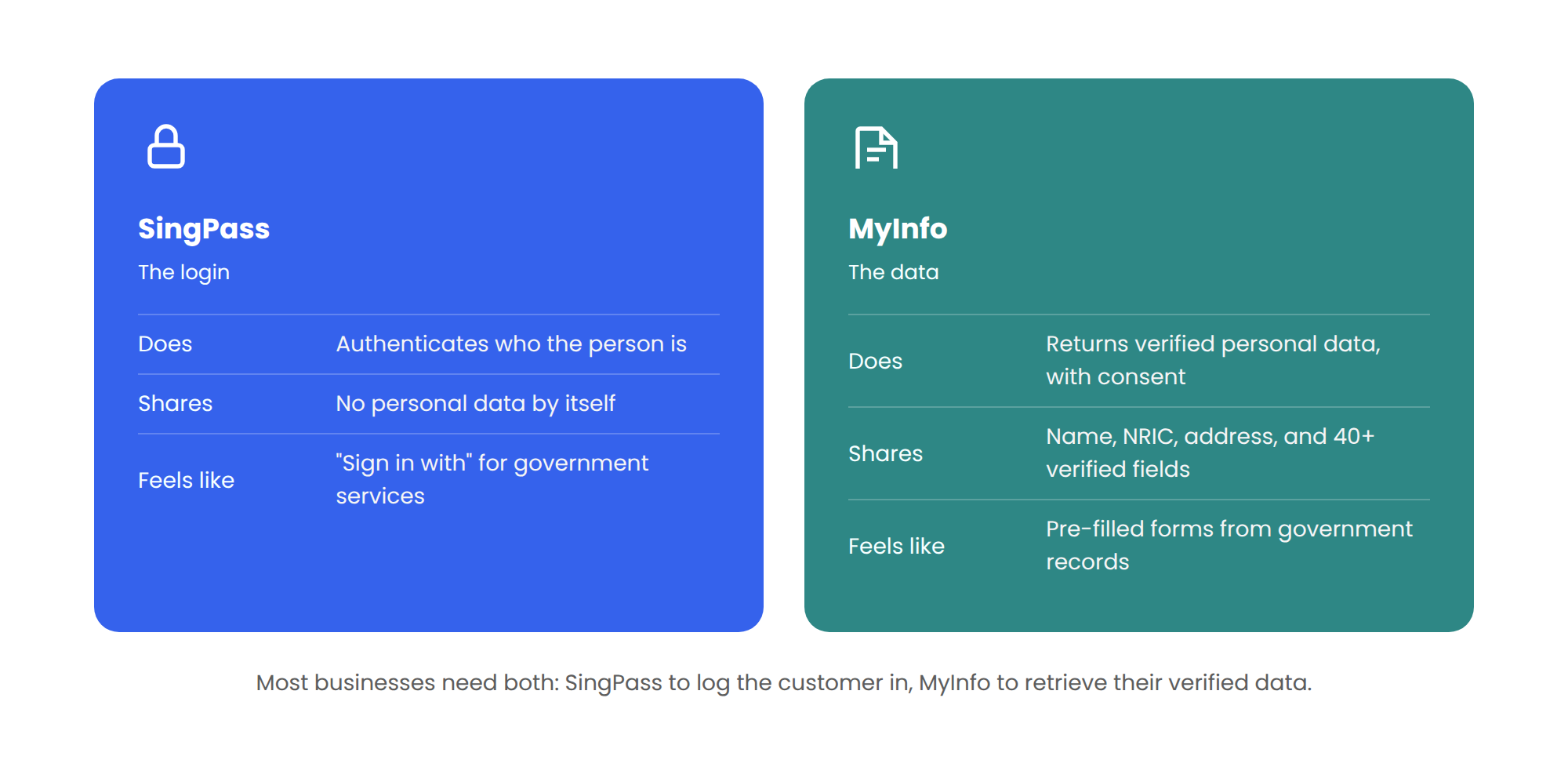
SingPass is the login layer.
- It authenticates that the person accessing a service is who they claim to be
- It uses credentials, biometrics, or the SingPass mobile app
- It doesn’t necessarily share any further personal data
- Adoption is high — most citizens and permanent residents use it
- It’s used across a wide range of government and private-sector digital services
MyInfo: Verified Data Built on Top of SingPass
MyInfo operates on top of a SingPass authentication. Once a resident logs in with SingPass, MyInfo can return a consented subset of their verified personal data.
- Data is sourced directly from government agencies — ICA, CPF Board, IRAS, and others
- It can include full name, date of birth, NRIC number, nationality, address, and employment information
- Because the data comes from government sources, businesses receive pre-verified information rather than self-declared data
- This reduces manual review and data entry errors during onboarding
How the MyInfo Verification Flow Works
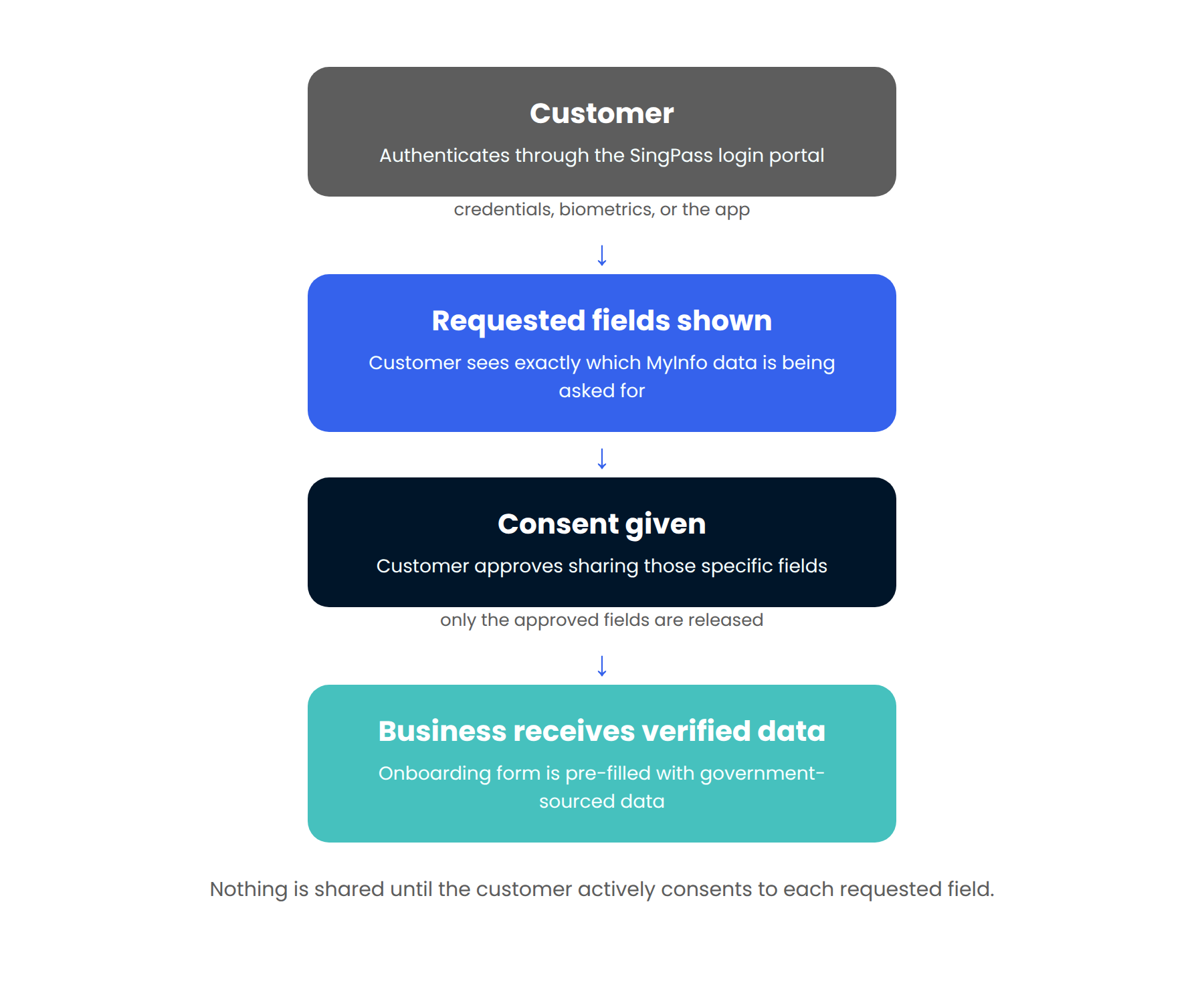
A typical MyInfo-based onboarding journey follows this sequence:
- The customer authenticates through the SingPass login portal, using credentials, biometrics, or the SingPass app
- After login, the customer is shown exactly which MyInfo data fields the business is requesting
- The customer reviews the request and gives explicit consent to share those fields
- The business receives the verified data directly from MyInfo, pre-filling onboarding forms and reducing the need for supporting documents
MyInfo Business for Corporate Onboarding
For business customers, MyInfo Business extends the same idea to corporate data.
- Company officers authenticate with individual SingPass
- The business itself authenticates with Corppass, Singapore’s corporate digital identity
- MyInfo Business can then retrieve verified company details from ACRA, including business profile, ownership, and financial highlights
- All of this still requires explicit consent
Regulatory Recognition for KYC
The Monetary Authority of Singapore (MAS) considers MyInfo and MyInfo Business reliable, independent sources for verifying a customer’s personal and corporate data.
Where MyInfo is used, MAS guidance says financial institutions don’t need additional identification documents to verify identity. That materially simplifies digital onboarding for banks and other regulated entities in Singapore.
Frequently Asked Questions
Do I need both SingPass and MyInfo for identity verification?
Most businesses that need both authentication and verified personal data use SingPass to log the customer in and MyInfo to retrieve their consented, verified details. If only a login is required, SingPass alone may be sufficient.
Is MyInfo data shared automatically once a customer logs in with SingPass?
No. Customers are shown exactly which data fields are being requested and must give explicit consent before any MyInfo data is shared with a business.
Can foreign residents use SingPass and MyInfo?
Foreign individuals with a registered Singpass Foreign user Account can use SingPass, and corresponding MyInfo data availability depends on which government records exist for that individual.
Does using MyInfo remove the need for further KYC checks?
MAS guidance recognises MyInfo as a reliable source for identity and corporate data verification, which can reduce the need for additional identity documents, though institutions still apply their broader risk-based Customer Due Diligence requirements.
What government agencies contribute data to MyInfo?
MyInfo draws on multiple government sources, including the Immigration and Checkpoints Authority, the Central Provident Fund Board, the Inland Revenue Authority of Singapore, and others, depending on the data field requested.
Ready to Strengthen Your Identity Verification Approach?
NameScan’s ID Verification service lets businesses confirm a customer’s identity in minutes rather than days, checking submitted documents against issuing-authority data and, where required, matching a live facial scan against the government-issued ID on file.
Customers can complete the check themselves via a personalised SMS or email link, with results delivered straight to a dashboard — typically within one to two minutes — making it a practical way to strengthen KYC and AML compliance without adding manual review overhead.
0 Comments