
Countries around the world take different approaches to verifying identity documents, from Australia’s centralised Document Verification Service to India’s Aadhaar eKYC and the EU’s upcoming Digital Identity Wallet.
This guide compares eight major systems side by side, so compliance and product teams can quickly understand how each one works and what it means for cross-border onboarding.
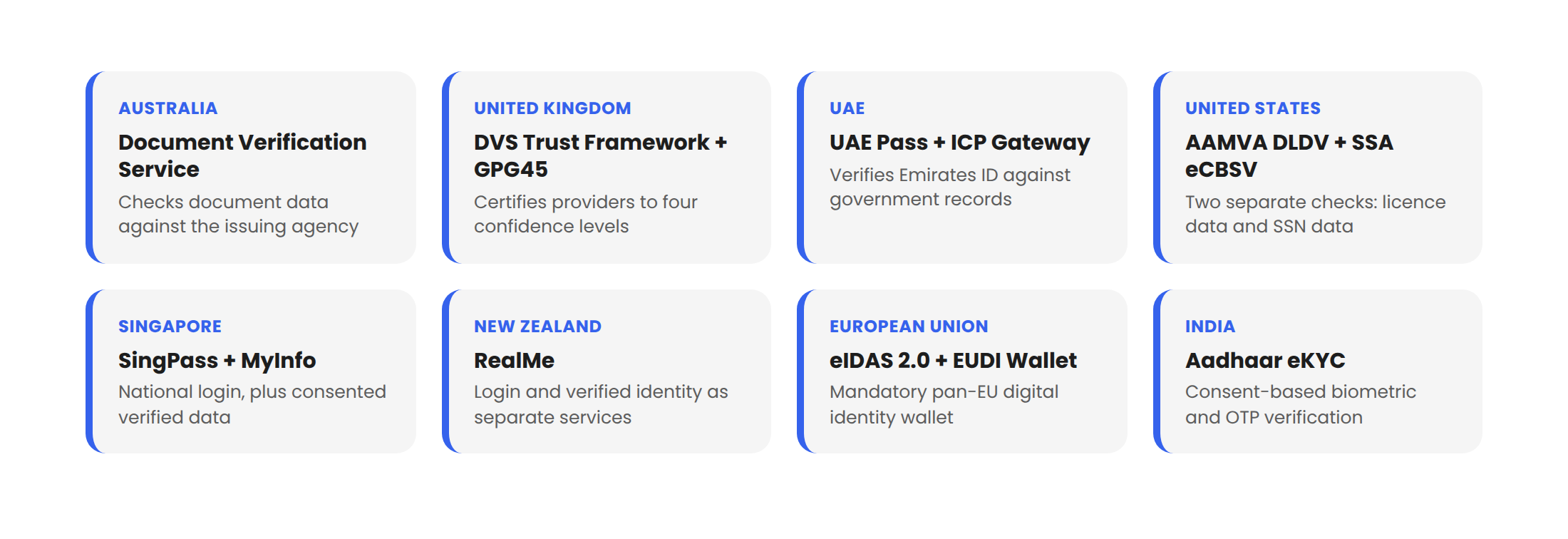
Australia: The Document Verification Service (DVS)
Operated by the Attorney-General’s Department, the DVS lets approved organisations check identity documents — a driver licence, passport, or Medicare card — against the records of the issuing agency.
- Returns a match or no-match result in seconds
- Doesn’t store personal data centrally
- Used by more than 3,500 organisations across Australia and New Zealand
United Kingdom: The DVS Trust Framework and GPG45
The UK doesn’t run a single government verification hub like Australia’s. Instead, it certifies private and public identity providers against the UK digital verification services trust framework.
- Uses Good Practice Guide 45 (GPG45) to define four confidence levels: low, medium, high, very high
- Placed on a statutory footing following the Data (Use and Access) Act 2025
United Arab Emirates: UAE Pass and the ICP Validation Gateway
The UAE centres identity verification on the Emirates ID, issued by the Federal Authority for Identity, Citizenship, Customs and Port Security (ICP).
- Regulated entities verify Emirates ID details through the ICP’s online Validation Gateway, or the UAE Pass application
- Both are recognised by the Central Bank of the UAE as compliant digital identification pathways
United States: AAMVA DLDV and SSA eCBSV
The US has no single national identity database. It relies on separate purpose-built systems.
- AAMVA’s DLDV service checks licence and state ID details against issuing state DMV records
- SSA’s eCBSV service checks whether a name, date of birth, and SSN combination matches SSA records
- Businesses typically combine both with document and biometric checks
Singapore: SingPass and MyInfo
SingPass provides national digital identity authentication. MyInfo, built on top of it, shares verified personal data sourced directly from government agencies, with explicit user consent.
The Monetary Authority of Singapore recognises MyInfo as a reliable, independent source for identity verification — reducing the need for additional identity documents during onboarding.
New Zealand: RealMe
Managed by the Department of Internal Affairs, RealMe splits authentication and identity assurance into two services.
- RealMe login: single sign-on, no identity assurance
- RealMe verified identity: checks a person’s details in real time against authoritative sources, such as the passport register
- Valid for reuse across almost 200 services for up to ten years
European Union: eIDAS 2.0 and the EUDI Wallet
Rather than a single existing hub, the EU is building toward a mandatory European Digital Identity Wallet under eIDAS 2.0 (Regulation (EU) 2024/1183).
- Every member state must offer a certified wallet by the end of 2026
- Obligated sectors, including banking, must accept it for onboarding from late 2027
- Gives the EU a harmonised, wallet-based approach once the rollout is complete
India: Aadhaar eKYC
Built on the Aadhaar number issued by UIDAI, Aadhaar eKYC lets a resident authenticate using an OTP or biometrics.
- UIDAI then shares digitally signed demographic data directly with an authorised service provider
- Its scale and speed have made it a widely referenced model for consent-based digital identity verification
Comparing the Approaches
Despite their differences, most of these systems share a common structure:
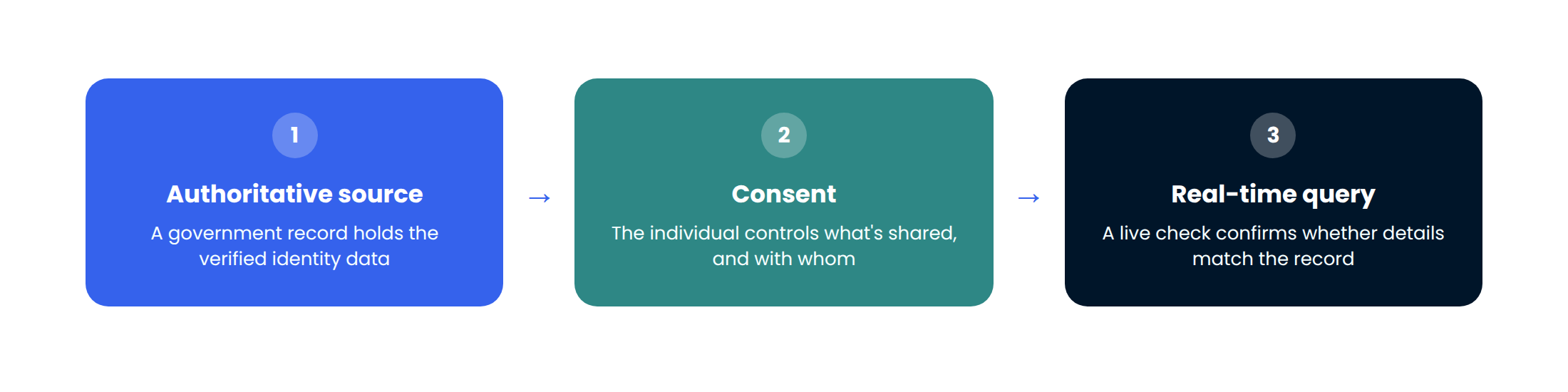
Where they differ
They differ most in scope — some verify a document, others verify a person via a national digital identity — and in maturity. Systems like Australia’s DVS and India’s Aadhaar eKYC have operated at national scale for years. The EU’s EUDI Wallet is only now entering its mandatory rollout phase.
For organisations verifying customers across borders, a single onboarding flow rarely works everywhere. Build flexibility into your identity verification process, so it can call on the right national source — a document hub, a digital identity app, or a wallet-based credential — for each jurisdiction. That tends to produce a more reliable, compliant outcome than treating one country’s approach as a universal template.
Frequently Asked Questions
Is there a single global standard for identity verification?
No. Each country or region has developed its own system, shaped by its own legal framework, government infrastructure, and privacy requirements, so a global KYC process needs to accommodate multiple national approaches.
Which of these systems verifies a document versus a person?
Systems like Australia’s DVS and the AAMVA DLDV service primarily verify document data against an issuer’s records. Others, such as MyInfo, RealMe verified identity, Aadhaar eKYC, and the upcoming EUDI Wallet, are built around verifying the person’s broader digital identity.
Do these systems replace the need for biometric checks?
Not usually. Most are commonly combined with biometric liveness or facial comparison checks, particularly to confirm that the person presenting the details is the rightful holder of the identity.
Which of these systems is the newest?
The EU’s European Digital Identity Wallet under eIDAS 2.0 is the newest at national scale, with member states required to make wallets available by the end of 2026 and private-sector acceptance obligations following in 2027.
How should a multi-country business approach identity verification?
Rather than adopting a single country’s model everywhere, most multi-country businesses build a modular verification process that can call on the appropriate national source, whether a document verification hub, a national digital identity, or a digital wallet, for each jurisdiction they operate in.
Ready to Strengthen Your Identity Verification Approach?
Wherever a business operates, a reliable identity verification process is central to compliant, low-friction onboarding. NameScan’s ID Verification service lets businesses confirm a customer’s identity in minutes rather than days, checking submitted documents against issuing-authority data and, where required, matching a live facial scan against the government-issued ID on file. Results are delivered straight to a dashboard, typically within one to two minutes, and the service runs on a pay-as-you-go basis with no long-term contract — making it a practical way to strengthen KYC and AML compliance without adding manual review overhead.
0 Comments