
The EU is rolling out one of the biggest changes to digital identity regulation anywhere in the world: eIDAS 2.0 and the mandatory European Digital Identity Wallet, or EUDI Wallet. For banks, payment institutions, and other entities subject to EU AML rules, this has direct implications for customer onboarding. This article covers what eIDAS 2.0 changes, how the EUDI Wallet will work, and what it means for AML and KYC.
From eIDAS to eIDAS 2.0
The original eIDAS Regulation, in force since 2014, created a legal framework for electronic identification and trust services. It enabled mutual recognition of qualified electronic signatures across EU member states.
But it left digital identity as a fragmented, national patchwork. There was no single European-wide digital identity credential.
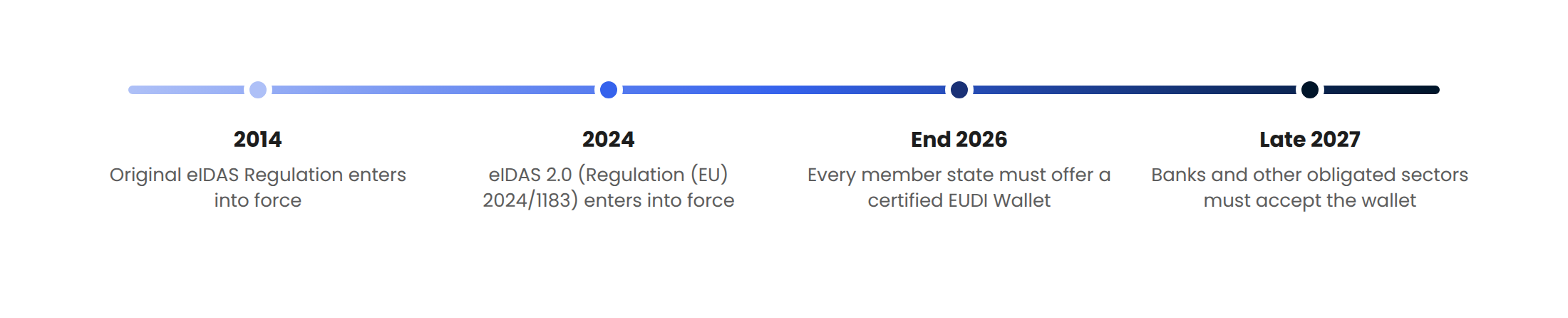
Regulation (EU) 2024/1183, known as eIDAS 2.0, entered into force in 2024. It amends the original regulation to establish a full European Digital Identity Framework. Its headline requirement: every member state must offer at least one certified EUDI Wallet to citizens, residents, and businesses.
What Is the European Digital Identity Wallet?
The EUDI Wallet is a government-backed digital wallet app.
- It lets individuals store verified identity attributes — name, date of birth, a driving licence, a professional qualification, a bank account link
- Users can share only the specific information a relying party actually needs
- Every national wallet must be built to a common technical specification, so it works consistently across all member states
- The underlying source code must be open-source, to support transparency
- A built-in dashboard must show users exactly which relying parties their data has been shared with
Key eIDAS 2.0 Deadlines
What This Means for AML Onboarding
The EU’s revised AML framework, including the new AML Regulation, explicitly recognises Qualified Electronic Attestations of Attributes and the EUDI Wallet as valid tools for Customer Due Diligence. Obligated financial institutions will be required to accept the EUDI Wallet for onboarding once the deadlines take effect.
In practice, a customer with a EUDI Wallet could share verified identity attributes with a bank in seconds during onboarding — instead of photographing a passport and waiting for manual or automated document review.
- This could reduce onboarding friction and drop-off rates
- It gives institutions a government-assured identity source, not a self-declared one
- Cross-border reliability still needs robust standards, testing, and interoperability between wallets issued in different member states
- Institutions still need their own risk-based AML controls, such as sanctions and PEP screening, layered on top
Why Identity Verification Is No Longer Optional
Identity verification has quietly become the load-bearing wall of digital trust. Every account opened, payment made, or service accessed online rests on an implicit answer to one question: is this person who they claim to be?
As that question moves from a compliance checkbox to a strategic concern, businesses face a genuine tension — regulators expect increasingly rigorous checks, while customers expect onboarding to take seconds, not days.
The organisations getting this right treat identity verification not as friction to be minimised or a box to be ticked, but as a foundation to be engineered: layering document checks, government data sources, and biometric confirmation so that trust is established quickly without being established carelessly.
As fraud tactics grow more sophisticated and identity systems around the world become more interconnected, verification strategy is quietly becoming a competitive differentiator, not just a regulatory cost.
Frequently Asked Questions
When must EU member states make the EUDI Wallet available?
Every EU member state is required to offer at least one certified EUDI Wallet to citizens, residents, and businesses by the end of 2026.
When will banks need to accept the EUDI Wallet for onboarding?
Obligated sectors, including banking, are expected to accept the EUDI Wallet as an authentication and identification method from late 2027, following the initial wallet availability deadline in 2026.
Does the EUDI Wallet replace existing AML checks?
No. The wallet provides a verified source of identity attributes for the identification step of Customer Due Diligence. Institutions still need to apply their broader risk-based AML controls, such as sanctions and PEP screening.
Is the EUDI Wallet the same across every EU country?
Each member state issues its own wallet, but all wallets must be built to the same common technical specification so they are interoperable and recognised across the EU.
What data can a EUDI Wallet share?
The wallet is designed around data minimisation, meaning a user can choose to share only the specific verified attributes a relying party requests, rather than their full identity profile.
Ready to Strengthen Your Identity Verification Approach?
Wherever a business operates, a reliable identity verification process is central to compliant, low-friction onboarding. NameScan’s ID Verification service lets businesses confirm a customer’s identity in minutes rather than days, checking submitted documents against issuing-authority data and, where required, matching a live facial scan against the government-issued ID on file.
Customers can complete the check themselves via a personalised SMS or email link, with results delivered straight to a dashboard — typically within one to two minutes — making it a practical way to strengthen KYC and AML compliance without adding manual review overhead.
0 Comments