
A suspicious matter report (SMR) is required when you suspect on reasonable grounds that something connected with a customer or a designated service may relate to crime. You lodge it through AUSTRAC Online, within 24 hours if the suspicion relates to terrorism financing and within 3 business days in other cases. You do not need to be certain, and you do not need complete information.
This guide was first published in 2023 and has been rewritten for the reformed AML/CTF regime that now covers Tranche 2 businesses. It is general information, not legal advice.
When you must lodge an SMR
AUSTRAC says you must submit an SMR if you suspect on reasonable grounds that, for example:
- information you have may be relevant to the investigation or prosecution of a crime
- a customer, a prospective customer or their agent is not who they claim to be
- a person is planning a money laundering or terrorism financing offence using a designated service
The obligation arises when you provide or propose to provide a designated service, or when someone asks you for one. It applies even if you decide not to provide the service. AUSTRAC also says that if you suspect on reasonable grounds that you hold information relevant to a contravention of Australia’s sanctions laws, you must submit an SMR.
AUSTRAC’s frequently asked questions make three further points that small firms often miss:
- you do not have to be sure a crime is being committed
- you should report even if you do not have complete information
- you must submit an SMR each time you form a new suspicion, including about an existing client you have reported before
The deadlines
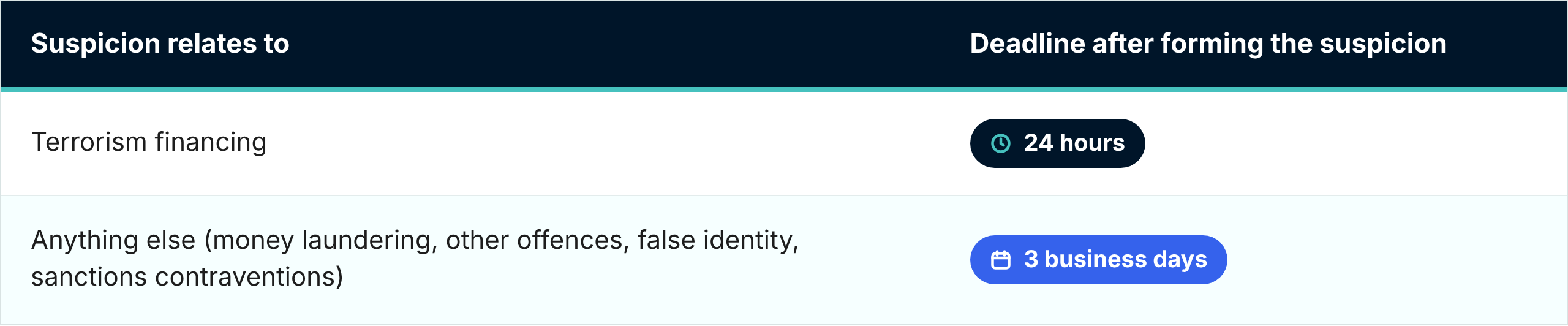
The clock runs from when you form the suspicion, not from when you finish investigating. If you are unsure whether a matter is suspicious, decide promptly and record your reasoning either way.
How to lodge an SMR in AUSTRAC Online
Reports are lodged through AUSTRAC Online, using the account set up when your business enrolled. AUSTRAC’s guidance describes the process:
- Log in to AUSTRAC Online.
- Select the option to submit a suspicious matter report and start a single report.
- Work through each section shown in the progress panel. All required fields must be completed before you can submit.
- Save a draft if you need to come back to it from your reporting dashboard.
- Review the summary, then submit. AUSTRAC acknowledges receipt.
Once submitted, a report cannot be deleted. If something is wrong, you need to ask AUSTRAC to withdraw or amend it. AUSTRAC provides a training environment in AUSTRAC Online so staff can practise the process. Do not use real information in a practice report.
AUSTRAC added new reporting forms from 1 July 2026. Businesses that were already enrolled on 30 March 2026 can move to the new forms between 1 July 2026 and 30 March 2029.
FROM SUSPICION TO SUBMITTED REPORT
The deadline runs from when the suspicion is formed.
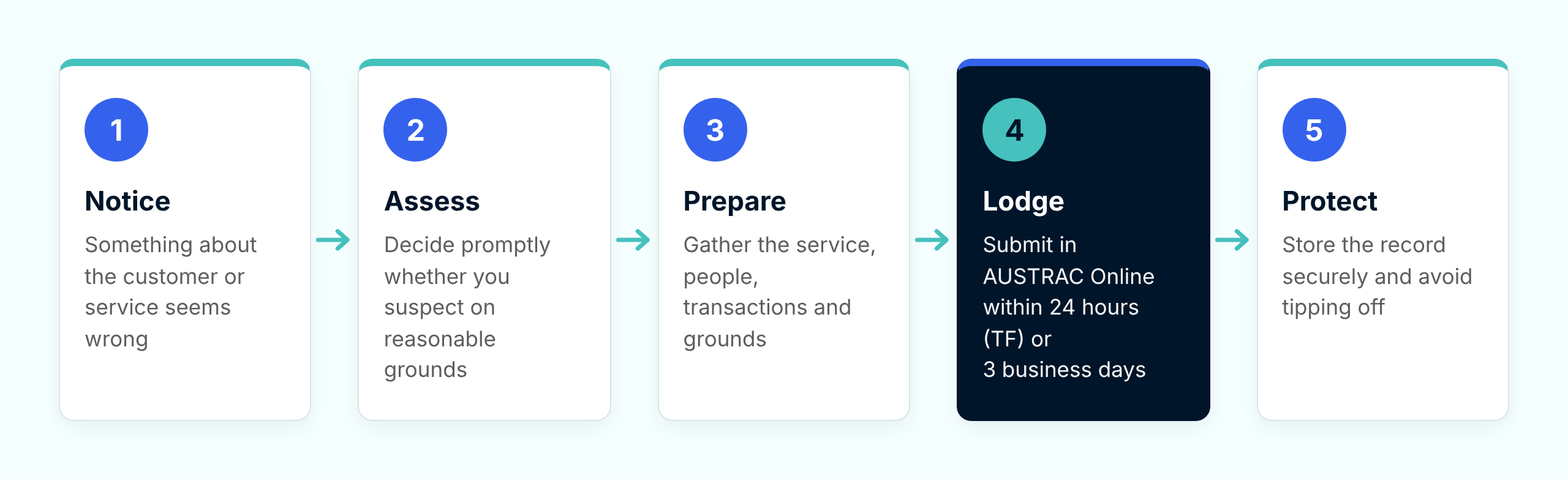 Figure 1. Illustrative SMR workflow. Your AML/CTF program sets who decides and who lodges.
What to include
AUSTRAC says an SMR should include details of the designated service you provided or proposed to provide, and why you formed the suspicion, with as much specific detail as you can about:
- the people or organisations the matter relates to
- any transactions connected with the suspicion
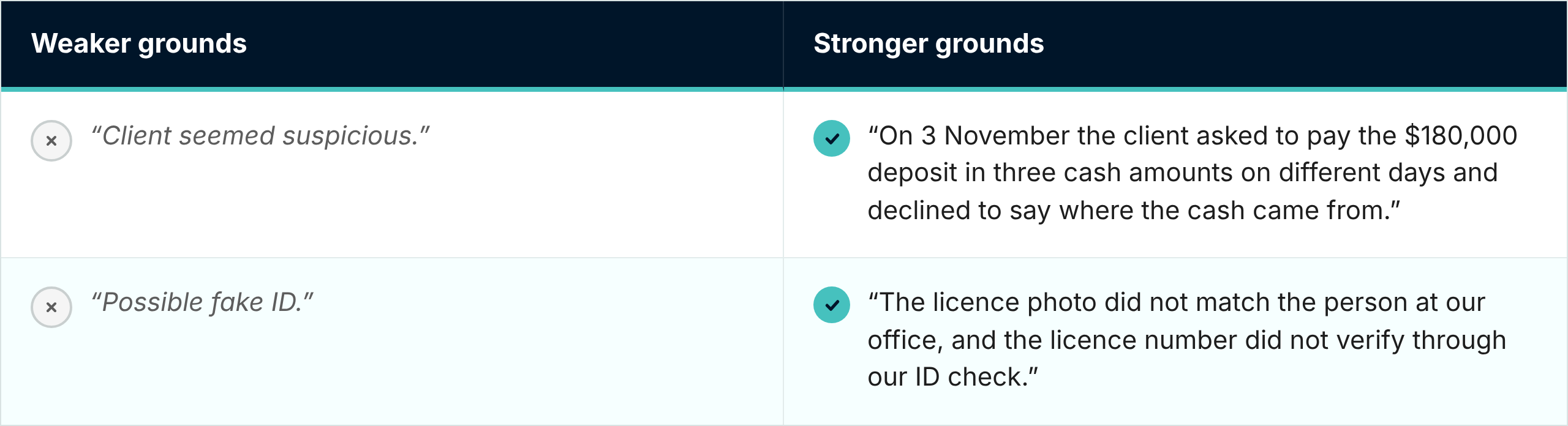
The most important part is the grounds for suspicion. AUSTRAC’s reference guide on more effective SMRs encourages grounds that are succinct, accurate and clear. In practice, that means writing what you observed, when, and why it concerned you, in plain language that someone outside your firm can follow.
What happens after you lodge
AUSTRAC uses SMRs as financial intelligence and shares them with law enforcement partners where appropriate. AUSTRAC’s reference guide notes that SMRs you submit are not admissible as evidence in court, which is designed to protect reporting businesses.
Three things then matter on your side:
- Tipping off. You must not disclose that you have lodged an SMR, or other protected information, where that could prejudice an investigation. See our guide to tipping off.
- Keep the SMR and your decision record securely and separately from the general client file, with access limited to authorised staff.
- The client relationship. You can decide to stop acting, but keep your explanation to the client neutral. If the client is a pre-commencement customer, the SMR obligation also means you must complete initial customer due diligence before providing them with another designated service.
Frequently asked questions
Do I need proof before lodging an SMR?
No. You need a suspicion on reasonable grounds. AUSTRAC says you do not have to be sure that a crime is being committed.
What if I decide not to act for the client?
The SMR obligation can still apply. It arises when you provide or propose to provide a designated service, or when someone asks you for one.
Can I delete an SMR if I made a mistake?
No. Once submitted it cannot be deleted. Ask AUSTRAC to withdraw or amend it.
Do I need to lodge another SMR about the same client?
Yes, each time you form a new suspicion.
Does a sanctions concern need an SMR?
If you suspect on reasonable grounds that you hold information relevant to a contravention of Australia’s sanctions laws, AUSTRAC says you must submit an SMR. Sanctions laws also require separate steps, such as freezing assets and notifying the Australian Sanctions Office and the AFP.
How NameScan can help
Many suspicions start with a screening result: a sanctions match, adverse media, or a PEP link that does not fit the client’s story. NameScan lets small firms run PEP, sanctions, and adverse media checks on a pay-as-you-go basis and record their decision on each result. Keep any SMR-related notes in your restricted compliance records, not with general screening results.
Spot the risk before it becomes a report
Screen clients for PEP, sanctions, and adverse media risk and keep a dated record of every decision.
0 Comments