
If you were already providing a designated service to a client before 1 July 2026, that client is likely to be a pre-commencement customer. You do not have to complete full initial customer due diligence (CDD) on them straight away, but you are not off the hook either. AUSTRAC’s guidance requires ongoing checks on these clients, and full initial CDD as soon as certain events happen.
This guide explains who counts as a pre-commencement customer, what still applies to them, which events change their status, and a step-by-step way to organise an existing client book. It is general information for Australian reporting entities, not legal advice. Your AML/CTF program and AUSTRAC’s current guidance set the detail for your firm.
Who counts as a pre-commencement customer
AUSTRAC’s guidance says a client is a pre-commencement customer if you have a business relationship with them that involves a designated service, and you provided a designated service to them before 1 July 2026. AUSTRAC updated this guidance on 1 July 2026 to focus on assessing the business relationship itself, including factors such as how long it has lasted, how recently you acted and whether further services are expected.
Two consequences follow for small firms:
- Clients who only ever received non-designated services are not pre-commencement customers for a new designated service. On AUSTRAC’s definition, the relationship must already have involved a designated service. An accounting client who has only had tax returns prepared, for example, needs initial CDD before their first designated service.
- Closed files and one-off past clients need care. Where there is no continuing business relationship, a returning client is likely to be treated as a new customer. Check your program and AUSTRAC’s examples for borderline cases.
What still applies to pre-commencement customers
Some early summaries of the reforms suggested existing clients needed no checks at all. AUSTRAC’s current guidance is clear that ongoing CDD applies. For pre-commencement customers you must:
- monitor for unusual transactions and behaviours that may give rise to a suspicious matter reporting obligation
- review, update and re-verify the client’s know your customer (KYC) information at an appropriate frequency, including whenever you have doubts about whether it is adequate or accurate
- monitor for significant changes in the nature and purpose of the business relationship that result in the client’s risk being medium or high
Screening is part of how a small firm meets these duties in practice. Sanctions listings change often, so a client who was clear years ago is not necessarily clear today.
The two triggers that require full initial CDD
AUSTRAC’s guidance says you must complete initial CDD on a pre-commencement customer before you provide a designated service when:
- a suspicious matter reporting obligation arises in relation to the client, or
- there is a significant change in the nature and purpose of the business relationship that results in the client’s money laundering, terrorism financing and proliferation financing risk being medium or high. AUSTRAC gives the example of a client requesting a new service in a way that is different from your existing relationship. It does not matter whether the client was rated medium or high before.
When a trigger occurs, treat the client as you would a new one for CDD purposes: identify and verify them, identify beneficial owners, screen everyone required, rate the risk and record it, before you provide the next designated service.
Sorting an Existing Client Book
Status depends on the relationship. Triggers bring a client into full initial CDD.
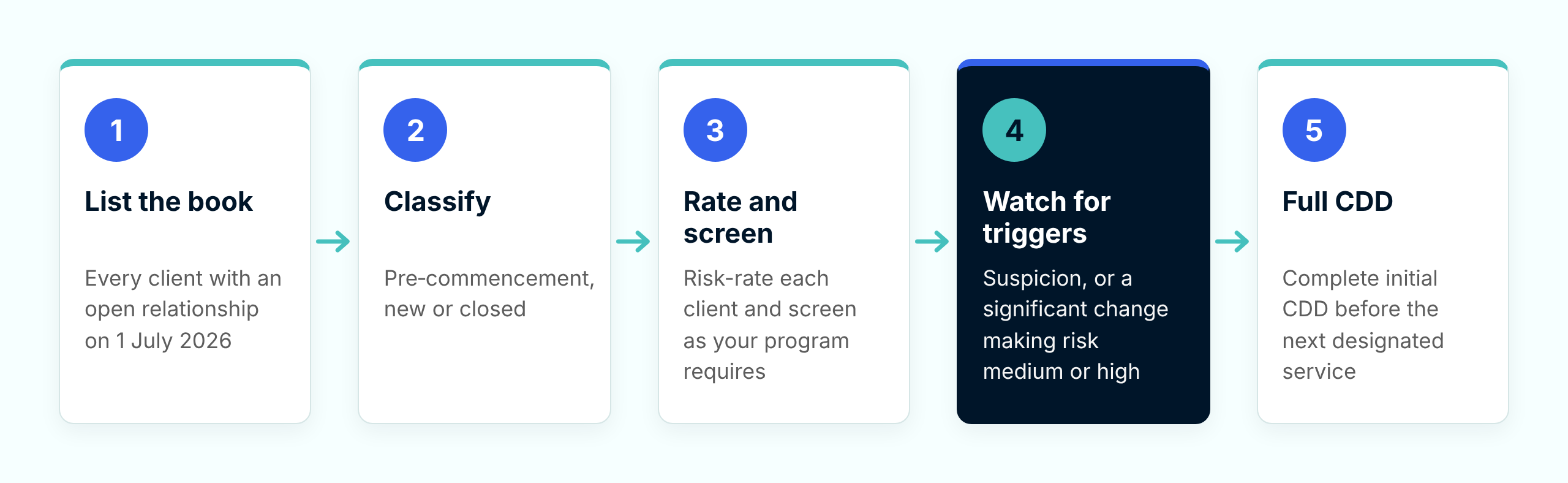 Figure 1. Illustrative workflow for organising pre-commencement customers. Your AML/CTF program sets the detail.
A step-by-step approach for a small firm
1. List the book
Pull a list of every client with an open matter or a continuing relationship as at 1 July 2026, with the services you have provided.
2. Classify each client
Mark each client as a pre-commencement customer, a new customer for any future designated service (for example, non-designated services only), or a closed relationship. Record the reason, because the classification decides what you do next.
3. Risk-rate and screen
You cannot spot a change that makes a client medium or high risk if nothing was rated to begin with. Give each pre-commencement customer a risk rating under your program and screen them, and their key associated people, against PEP, sanctions and adverse media data. A batch screen can handle a whole book in one pass.
4. Set review points
Use the ratings to set when each client’s KYC information is next reviewed and re-screened, and flag high-risk clients for closer monitoring.
5. Build the triggers into file opening
Any new instruction should prompt a quick question: is this a new service, or the same service delivered in a different way? If yes, assess whether the change makes the client medium or high risk. If it does, complete initial CDD before you act.
6. Record decisions
Keep a note of each classification, rating, screening result and trigger assessment with the client’s CDD records. Records generally need to be kept for 7 years after the business relationship ends.
A worked example
Illustrative example. A law firm has acted for a property investor since 2022 on residential purchases, which are designated services under Tranche 2. The investor is a pre-commencement customer. In November 2026, the investor asks the firm to help set up a company with two overseas shareholders to buy a commercial building. That is a new kind of service delivered in a different way, and the overseas ownership raises the risk to medium. The firm completes initial CDD, including identifying and screening the overseas shareholders, before it starts work on the new matter.
Frequently asked questions
Do I have to re-verify every existing client on 1 July 2026?
No. Pre-commencement customers do not need full initial CDD until a trigger occurs. Ongoing CDD, including monitoring and reviewing KYC information at an appropriate frequency, still applies.
What makes a change ‘significant’?
AUSTRAC’s example is a client requesting a new service in a way that is different from the existing relationship. The change must result in the client’s risk being medium or high for this trigger to apply.
Does a suspicious matter report end pre-commencement treatment?
If a suspicious matter reporting obligation arises in relation to the client, you must complete initial CDD before providing a designated service to them.
Is a client who only had non-designated work a pre-commencement customer?
On AUSTRAC’s definition, no. The relationship must have involved a designated service before 1 July 2026, so the first designated service needs initial CDD.
Should I screen my existing clients now?
Screening is a practical way to meet ongoing CDD, establish a baseline risk rating and catch sanctions changes. Your AML/CTF program should set how and when.
How NameScan can help
NameScan lets small firms screen an existing client book against PEP, sanctions and adverse media data on a pay-as-you-go basis, including batch screening from a single CSV file, and record the decision for each result in the dashboard. That gives you a dated baseline for every pre-commencement customer.
Screen your existing client book
Run a baseline PEP, sanctions, and adverse media check on your pre-commencement customers, with a dated record for each.
0 Comments