
Sanctions screening means checking your customers against official lists of sanctioned people, companies and ships. You should also check the people and businesses linked to your customers.
If a customer is on a list that applies to you, you may be banned from dealing with them. You may also have to freeze their money or other assets.
Four lists come up most often:
- the US OFAC SDN List
- the UN Security Council Consolidated List
- the EU consolidated financial sanctions list
- Australia’s DFAT Consolidated List
These lists overlap, but they are not the same. The ones you need depend on where you operate, who you are and who you deal with.
This guide explains each list in plain English. It is general information, not legal advice. If you find a possible match, follow your procedures and get legal advice where needed.
How the four lists fit together
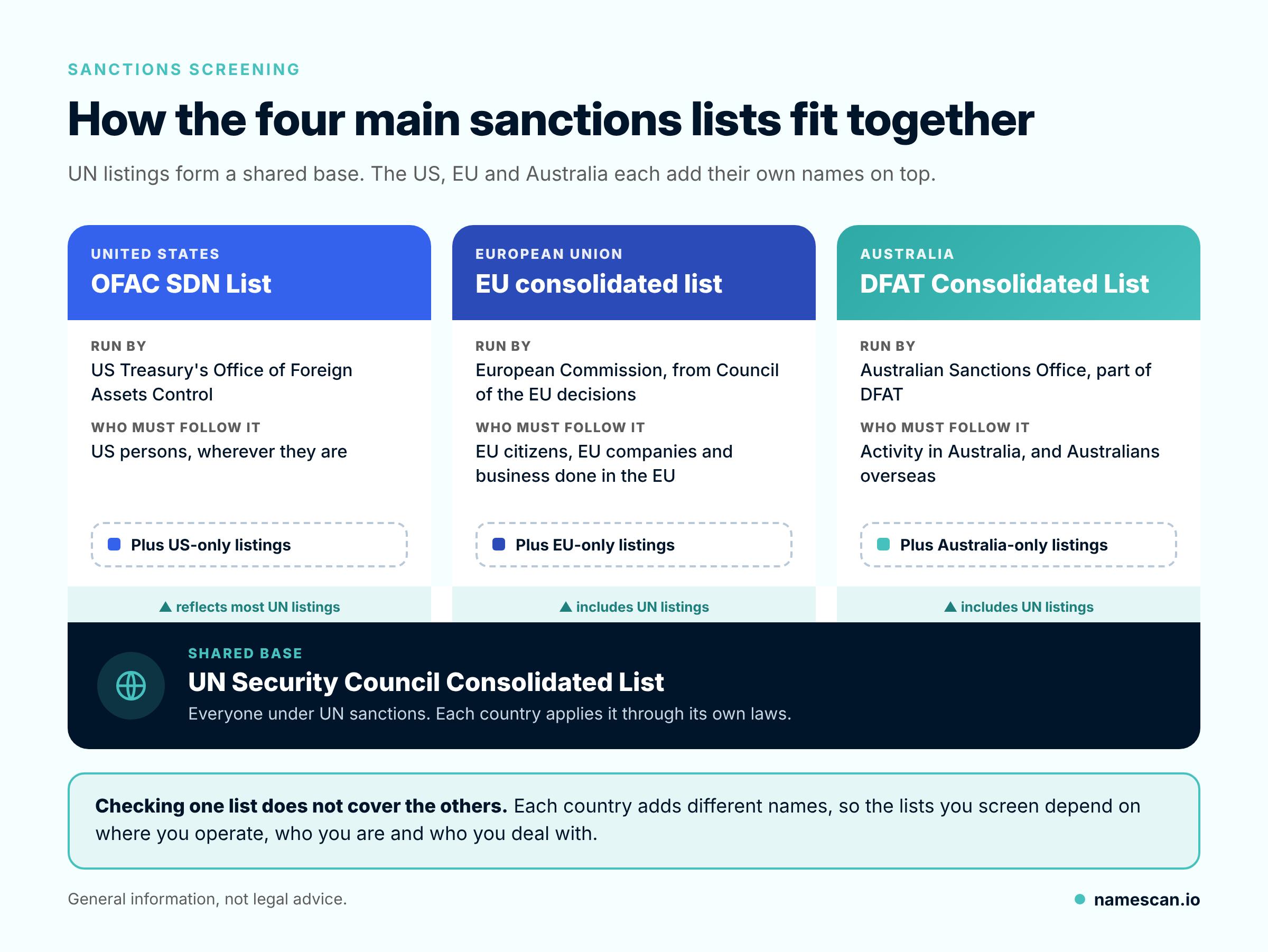
The OFAC SDN List (United States)
OFAC publishes the Specially Designated Nationals and Blocked Persons List, known as the SDN List. It includes:
- people and companies owned or controlled by, or acting for, sanctioned countries
- people and groups listed under other programmes, such as terrorism and drug trafficking
The assets of anyone on the SDN List are blocked. US persons are generally banned from dealing with them. OFAC updates the list often, with no fixed schedule.
Two points matter if you are outside the US:
- US sanctions can still reach you. This can happen if your deals involve US dollars, US banks or US partners.
- Ownership counts. Under OFAC’s 50 Percent Rule, a company is treated as sanctioned if sanctioned people own 50% or more of it in total. This applies even if the company is not on the list. So you also need to know who owns your customer.
The UN Security Council Consolidated List
This list brings together everyone under UN Security Council sanctions. Each sanctions programme has its own committee. Being on the list does not mean every name faces the same measures.
The UN does not enforce sanctions on businesses directly. Each country does that through its own laws. In Australia, for example:
- UN sanctions apply through the Charter of the United Nations Act 1945 and related regulations
- UN-listed people and companies appear on the DFAT Consolidated List
The EU consolidated financial sanctions list
The EU calls its sanctions ‘restrictive measures’. The Council of the EU adopts them one programme at a time. The European Commission then combines everyone under EU financial sanctions into one list. You can download it in PDF, CSV or XML format.
One detail to note: the legal source is the EU’s Official Journal. A new listing can take effect shortly before it appears in the combined list.
EU sanctions apply:
- within EU territory
- to EU citizens, wherever they are
- to companies set up under the law of an EU country
- to business done fully or partly in the EU
Are you outside the EU? If you have EU customers, EU offices or a European bank in your payment chain, check whether EU sanctions apply to you.
The DFAT Consolidated List (Australia)
The Australian Sanctions Office (ASO), part of the Department of Foreign Affairs and Trade (DFAT), runs the Consolidated List. It includes everyone subject to Australian sanctions. That covers:
- people and companies listed by the UN Security Council
- people, companies and ships listed by Australia’s Foreign Minister under Australia’s own sanctions laws
Each entry can include names and aliases, dates and places of birth, citizenship and addresses. These details help you tell a real match from someone with a similar name.
Australian sanctions laws apply to activity in Australia. They also apply to Australian citizens and companies overseas. In most cases they ban you from:
- giving money or other assets to a listed person or company
- using or dealing with assets they own or control
What are the penalties in Australia?
The penalties are serious. According to DFAT, as of 1 July 2026:
- Individuals face up to 10 years in prison. They can also be fined up to 2,500 penalty units ($910,000) or three times the value of the deal, whichever is greater.
- Companies can be fined up to 10,000 penalty units ($3.64 million) or three times the value of the deal, whichever is greater.
For companies, these are strict liability offences. This means intent does not need to be proven. A company can defend itself if it shows it took reasonable precautions and did proper due diligence. A recorded screening process helps show this.
The DFAT list only covers Australian sanctions. It does not include people listed only by other countries.
Which lists should your business screen?
There is no single answer. These questions usually settle it:
- Where are you based? An Australian business must follow Australian sanctions, which include UN listings. An EU company must follow EU sanctions.
- Who works for or owns your business? US citizens and permanent residents count as US persons wherever they work.
- Which currencies and banks do you use? Using US dollars or US banks can bring US sanctions into play. Your bank may also expect you to screen more lists.
- Where are your customers? Links to sanctioned countries raise your risk.
- What does your risk assessment say? If AUSTRAC regulates you, you should be able to explain why you screen the lists you do.
Many smaller businesses screen all major lists in one go. It is simpler than deciding list by list for each customer.
What to do with a possible match
A possible match is a starting point, not an answer. Most turn out to be different people with similar names. Never ignore a match, and never confirm one without proper review.
- Pause. Do not provide the service or move money until the match is resolved.
- Compare details. Check name and aliases, date of birth, nationality and address. For companies, check registration numbers. OFAC suggests two questions. Is the name an exact or very close match? Is the customer in the same area as the listed person?
- Ask for more if needed. Request another ID document or details that tell the two apart.
- Record your decision. Note what you compared, what you decided and who decided.
- Escalate a likely real match.
- In Australia, DFAT advises getting legal advice before going ahead.
- If you hold assets owned or controlled by a listed person, you must freeze them and tell the ASO and the Australian Federal Police.
- For a strong OFAC match, OFAC directs businesses to its compliance hotline.
- Check other reporting duties. If AUSTRAC regulates you, consider whether you need to lodge a suspicious matter report.
How NameScan can help
With NameScan, you can:
- screen people and businesses against OFAC, UN, EU, UK, Australian and other major sanctions lists in a single check
- run PEP and adverse media screening at the same time
- rely on data that is updated daily
- see the details you need to compare a possible match
- keep a timestamped report of each check as evidence
- run one-off checks, upload a batch or connect through the API
- pay per check instead of a subscription
Screening is one part of sanctions compliance. It does not replace legal advice on a real match or your wider AML/CTF duties.
Frequently asked questions
Which sanctions lists do Australian businesses need to check?
Australian businesses must follow Australian sanctions laws. The DFAT Consolidated List covers these, including UN listings. Many businesses also check the OFAC, EU and UK lists, especially if they deal in US dollars or with overseas customers.
Does OFAC apply to companies outside the US?
OFAC rules bind US persons. But non-US businesses can still be affected if their deals involve US dollars, US banks or US partners. Many banks around the world also expect their customers to respect OFAC sanctions.
How often are sanctions lists updated?
There is no fixed timetable. Lists can change any day, often when new sanctions are announced. This is why you should screen against data that is kept up to date.
Can I check sanctions lists for free?
Yes. OFAC offers a free online search tool. DFAT publishes its Consolidated List as a free download. You can also run a free check with NameScan to screen several lists at once.
What happens if I deal with a sanctioned person by mistake?
In Australia, dealing with a sanctioned person can be a criminal offence, even without intent for companies. If this happens, stop the dealing and freeze any assets as required. Then tell the ASO and the Australian Federal Police, and get legal advice.
Next step
Try a free sanctions check on a customer name to see how results look. Or learn more about NameScan sanctions screening.
0 Comments