
RealMe is New Zealand’s government-backed digital identity service. It lets residents log into government and approved private-sector services, and — where needed — prove their identity online without an in-person visit.
It’s managed by the Department of Internal Affairs (DIA) and used by dozens of government agencies plus a growing list of banks, insurers, and other private organisations.
This article covers RealMe’s two components, how identity verification actually works, and where it fits into AML and Customer Due Diligence obligations.
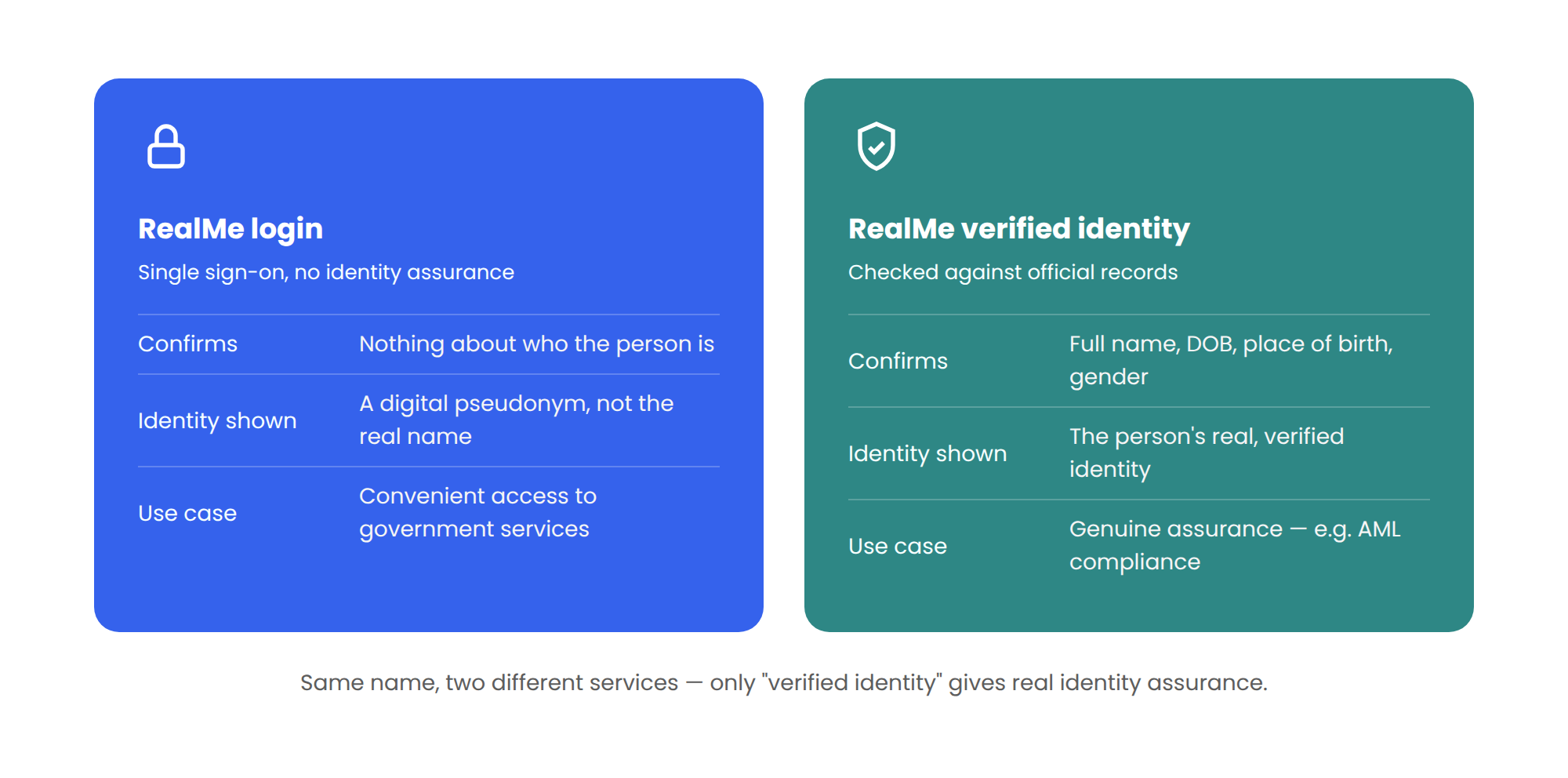
RealMe Login vs RealMe Verified Identity
How RealMe Verified Identity Works
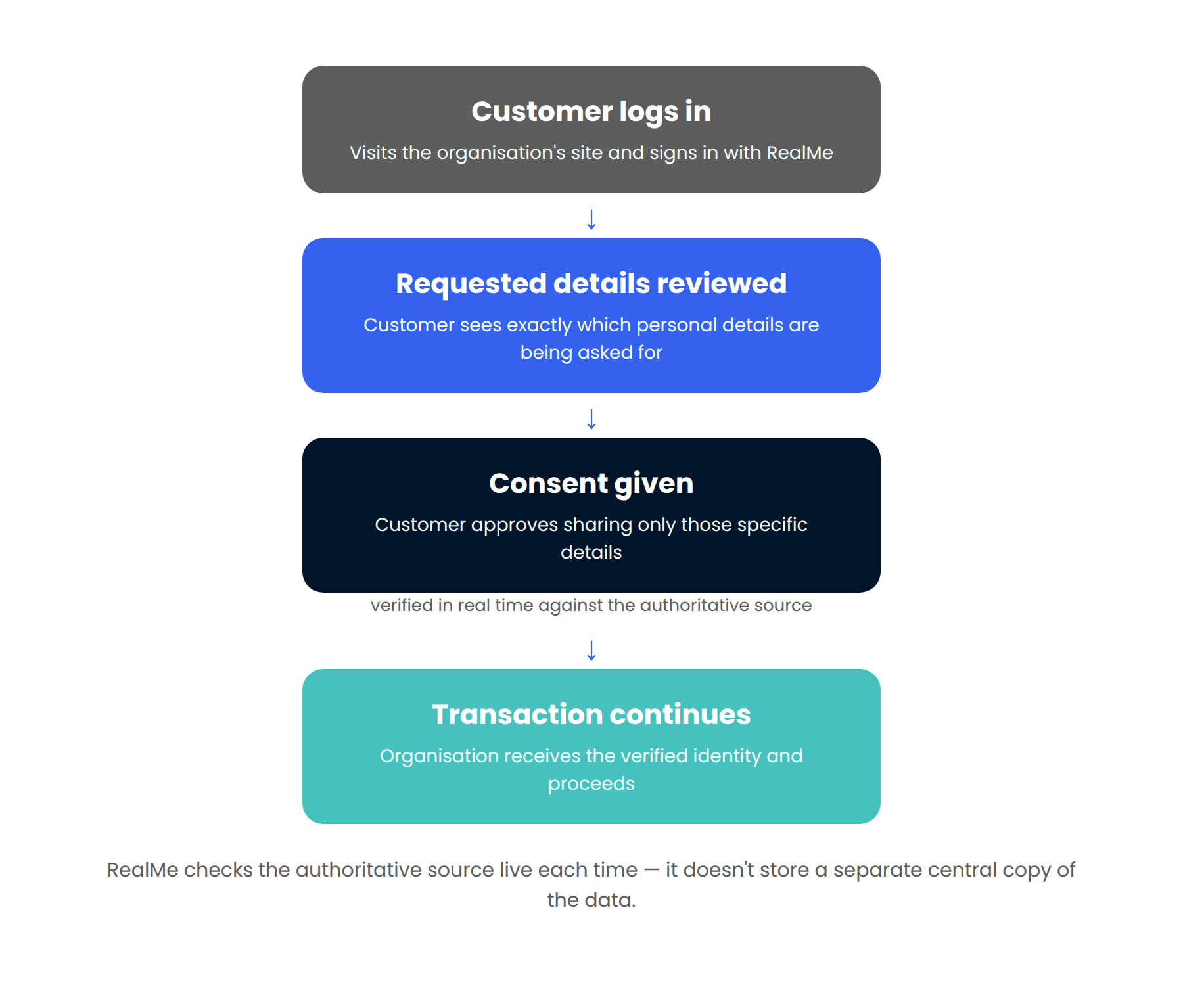
RealMe doesn’t store a central copy of a person’s identity details. Instead, it draws on an authoritative source — most often DIA’s passport database — and checks it in real time whenever a verification is requested, always with consent.
To get a RealMe verified identity, an applicant completes an online application:
- Applicants with a New Zealand passport can take their own photo online
- Others need their photo taken at a participating photo store or authorised agent
- DIA’s Identity Verification Service checks the submitted photo and identity details against official records
- Once verified, the identity is valid for ten years and reusable across almost 200 government and commercial services
Sharing a Verified Identity With an Organisation
When an organisation needs to confirm a customer’s identity, the process is simple:
Verification Is Only as Strong as Its Weakest Layer
No single check is sufficient on its own, and treating any one of them as sufficient is where most verification programs quietly fail. A document can be genuine but stolen. A database match can be correct but not prove liveness. A face can match a photo that was itself fraudulently obtained.
It’s not so much about finding the one perfect check that makes identity verification strong. Instead, it’s about putting together several checks that don’t overlap. For example, a biometric action, a document that the person has, and a data match that the government confirms are all combined into a much stronger combination than any single layer alone.
Ready to Strengthen Your Identity Verification Approach?
NameScan’s ID Verification service lets businesses confirm a customer’s identity in minutes rather than days, checking submitted documents against issuing-authority data and, where required, matching a live facial scan against the government-issued ID on file.
Customers can complete the check themselves via a personalised SMS or email link, with results delivered straight to a dashboard — typically within one to two minutes — making it a practical way to strengthen KYC and AML compliance without adding manual review overhead.
Frequently Asked Questions
What is the difference between RealMe login and RealMe verified identity?
RealMe login is an authentication service with no identity assurance, using a pseudonym rather than the person’s real name. RealMe verified identity checks a person’s actual identity details against government records and provides genuine identity assurance.
How long does a RealMe verified identity last?
A RealMe verified identity is valid for ten years and can be renewed online, and it can be reused across nearly 200 participating government and commercial services during that time.
Which organisations can use RealMe?
RealMe is used by numerous government agencies and by an expanding list of private-sector organisations, including registered banks, insurers, and other regulated businesses, once they have set up an integration with the Department of Internal Affairs.
Does RealMe store my identity data centrally?
No. RealMe draws on information held by authoritative government sources, such as the passport database, and verifies it in real time rather than storing a separate central copy.
How does RealMe support AML compliance in New Zealand?
Because RealMe verified identity checks a person’s details against authoritative government records with their consent, organisations can use it to help meet their identity verification obligations under New Zealand’s anti-money laundering requirements.
0 Comments